How Much Does Google AdSense Pay per 1,000 Views? (2026 Guide)
The definitive 2026 manual on revenue benchmarks, growth and optimization.
Try the Adstimate AdSense CalculatorQuick Navigation:
1. The 2026 AdSense Reality
I’m going to be brutally honest with you: if you’re still chasing "pageviews" like it’s 2019, you’re essentially working for free. I see it all the time—publishers bragging about hitting 100k views while their actual bank balance looks like a teenager’s weekend allowance.
One of the biggest "aha!" moments I had was realizing that one visitor from the US was worth more to my bank account than twenty visitors from a low-RPM country. I shifted my entire content strategy in three days, and my revenue doubled without my traffic growing at all. It wasn't magic; I just stopped acting like a traffic-hoarder and started acting like a business owner.
We’ve officially entered the era of Generative Search and Consent-Based Tracking. In 2026, the old "set it and forget it" strategy is dead. Simple traffic volume isn't king anymore; Quality of Intent is. If you aren't capturing a user who is actually looking to do something, buy something, or solve something, Google’s AI is going to value your ad space at next to nothing.
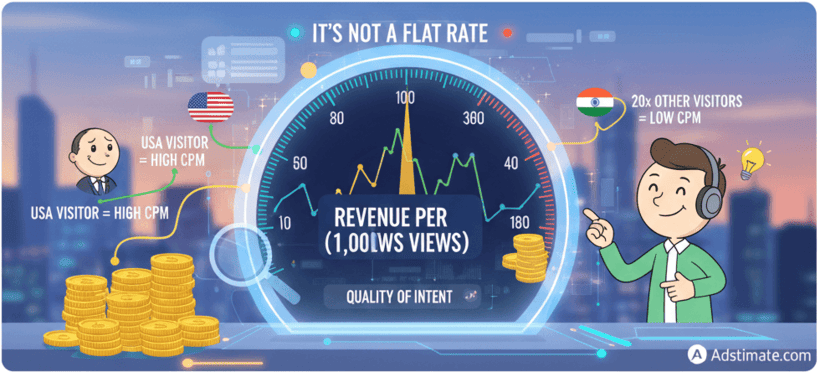
Here’s the massive win for 2026: AdSense has fully transitioned to a CPM-first model. This means you’re paid for every 1,000 times an ad is viewed, not just when someone accidentally clicks a banner. For long-form, "meat on the bone" pages like this one, that’s a game-changer. Because you’re actually providing value and keeping people on the page, they trigger more ad refreshes. You’re making more money from the same visitor just because they didn't bounce in three seconds.
Sound familiar? You’re working harder than ever, but the math isn't mathing. Let's fix that!
2. The Math of RPM: How Your Pay is Calculated
To understand your earnings, you must look past your daily balance and master Page RPM (Revenue Per Mille). This metric tells you exactly how much your content is worth per 1,000 human eyes.
The formula is simple but powerful:
Page RPM = (Estimated Earnings / Number of Pageviews) × 1,000
However, your RPM is composed of two "hidden" ingredients:
- Bid Density: How many advertisers are fighting to show an ad on your specific page. High-value pages attract 50+ bidders, driving the price up.
- Attention Metrics: In 2026, Google measures how long an ad is actually visible on the screen. If a user scrolls past an ad in 0.5 seconds, it pays less than an ad they look at for 5 seconds. This is why well-structured, readable content is now a financial requirement.
Further Reading:
Learn more about starting your journey: Can New Websites Make Money With AdSense?
3. Traffic Milestones: 1k to 1M View Benchmarks
As you scale your traffic, your revenue doesn't just grow linearly—it often "snowballs" because high-traffic sites attract more premium, high-paying advertisers.
- The 1,000 Views Milestone: At this stage, you are in the "Data Gathering" phase. You can expect $5 to $30 depending on your niche. This is where you test which ad placements work best for your layout.
- The 100,000 Views Milestone: This is the "Full-Time Income" threshold. With a standard 2026 RPM of $15.00, 100k views translates to $1,500/month. For most bloggers, this is the point where they leave generic AdSense and start using "Auto-Ads" to let Google's AI maximize their layout.
- The 1,000,000 Views Milestone: You are now a Media House. At this scale, your monthly revenue can range from $10,000 to $50,000+.
Deep Dive:
See the full scaling breakdown: AdSense Revenue for 100k and 1M Views.
4. High-Paying Industry Clusters
Not all pageviews are created equal. If 1,000 people read a "Celebrity Gossip" post, the ads shown will be for cheap consumer goods (Low CPC). If 1,000 people read about "Corporate Liability Insurance," the ads shown are for services worth $10,000+ to the advertiser.
If you want to maximize your payout, you must target industries where advertisers are willing to pay a premium for a lead. By focusing on the highest paying AdSense niches in 2026, such as Legal, Insurance, and SaaS, you can earn 10x more than a general entertainment site with the exact same amount of traffic.
The Top Tiers for 2026:
- Legal & Insurance: Keywords like "Accident Attorney" can still command $50+ per click.
- B2B Software (SaaS): Businesses pay a premium for users looking for "Best CRM" or "Cybersecurity for Startups."
- Personal Finance: Credit cards, mortgage refinancing, and cryptocurrency "DeFi" security are the evergreen giants of the AdSense world.
Explore Niches:
Check our 2026 list: The Top 20 Highest Paying AdSense Niches.
5. Global Geography Tiers (US vs. The World)
The single biggest influence on your RPM—often even more than your niche—is where your visitors live. Advertisers bid based on the purchasing power of the audience. A click from a user in New York is worth significantly more than a click from a user in Mumbai because of the advertiser's potential Return on Investment. To see where your specific audience falls, refer to our AdSense RPM by Country: 2026 Tier List. In 2026, we categorize the world into three distinct revenue tiers.
- Tier 1 (The Power Markets): Includes the USA, UK, Canada, Australia, and Gemany. In these countries, the advertising market is highly competitive. Expect RPMs between $15 and $45.
- Tier 2 (The Growth Markets): Includes Brazil, Mexico, Spain, Italy, and much of Eastern Europe. These economies have high internet penetration but slightly lower advertiser spend. RPMs typically range from $5 to $15.
- Tier 3 (The Volume Markets): Includes India, Pakistan, Philippines, and much of Africa. While traffic volume is massive in these regions, the cost of advertising is low. RPMs often sit between $0.50 and $5.
Geography Report:
See the global rankings: AdSense RPM by Country: 2026 Tier List.
6. Survival in the AI Era: Protecting Your Revenue
The rise of "Search Generative Experience" (SGE) has changed how users consume content. If your article only provides a simple fact (e.g., "What is the capital of France?"), Google's AI will answer it on the search page, and you will get zero clicks.
To maintain a high RPM in 2026, your content must offer Information Gain. This means providing something an AI cannot:
- Personal Experience: "I tested these 5 niches for 6 months."
- Proprietary Data: Using tools like your Adstimate calculator to provide unique numbers.
- Expert Analysis: Explaining the why behind the trends. Google prioritizes sites with high E-E-A-T (Experience, Expertise, Authoritativeness, and Trust), and these sites receive the highest-paying "Premium" ad placements.
7. Doubling Your Earnings: 3 Technical Fixes
You don't always need more traffic to make more money. Often, you just need to optimize how your ads are served.
- Optimize for "Core Web Vitals": Google's auction favors fast sites. A 1-second delay in page load can decrease your ad viewability by 20%, directly cutting your revenue.
- Strategic Ad Refresh: In 2026, top-tier publishers use Smart Refresh technology—often through premium networks or Google Ad Manager—to update ads while a reader stays on a long page. While basic AdSense prohibits manual refreshing, you can mimic this by enabling Sticky Anchor Ads and Auto-Ads, which allow Google's AI to refresh your ad inventory safely.
- High-Intensity Keyword Injection: Ensure your headers (H2 and H3) include high-intent keywords. If your header is "How to save money," change it to "High-Interest Savings Account Strategies." The latter attracts much higher-paying ads.
Final Thoughts
In 2026, AdSense remains one of the most reliable ways to monetize, but success requires a strategic focus on high-value niches and Tier 1 traffic. By monitoring your RPM and optimizing your content, you can maximize every thousand views your site receives.